
Why do Political Parties exist?
The U.S. Constitution Never Mentioned Them, So Where Did Parties Come From?

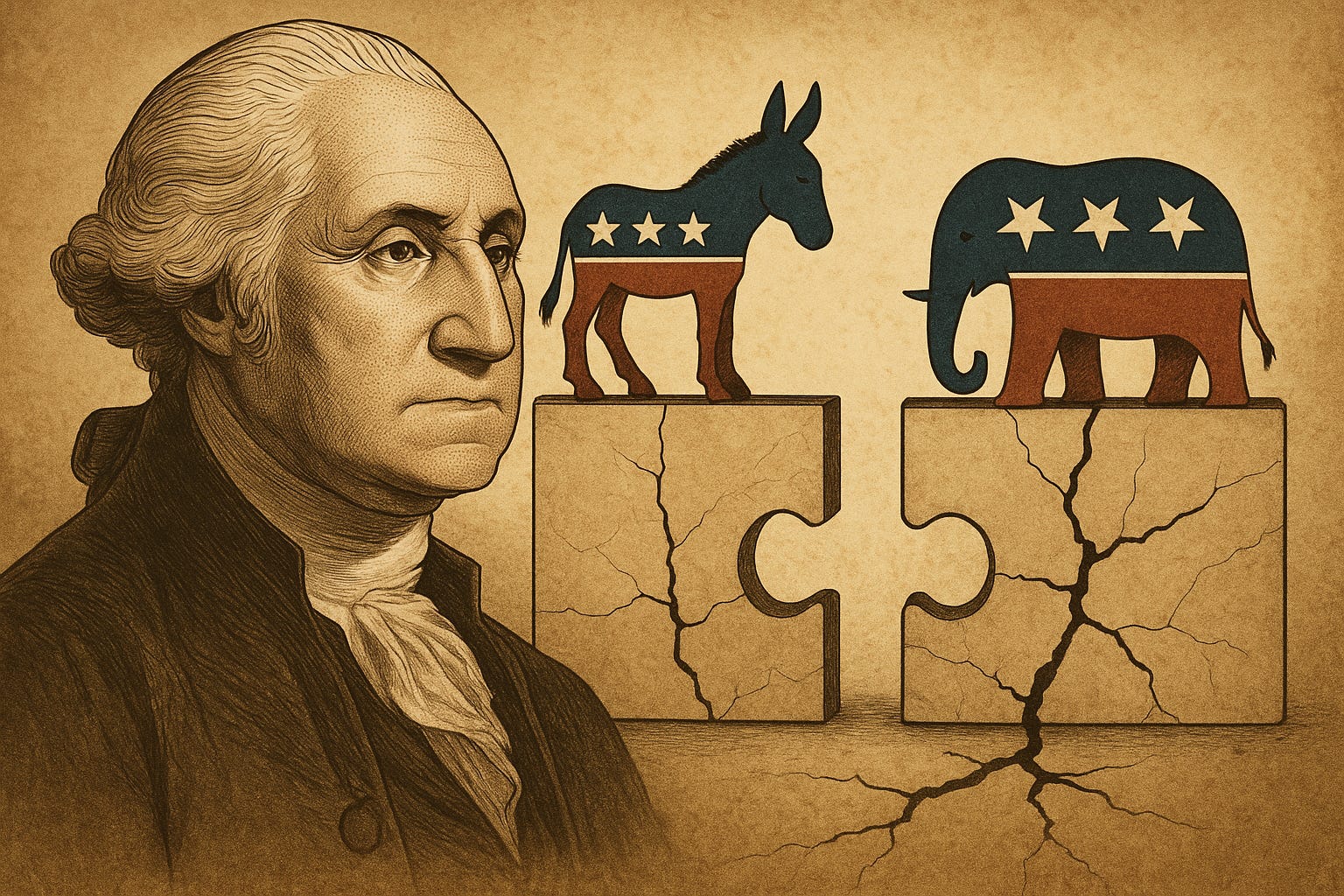
This may be the most boring blog I’ve written, but I mainly do blogs because I’m curious about something and want to research it to understand it deeper. Having to write about a topic generally brings forth deep understanding.
I hear people complain about the two party system, however there is no mention of political parties in the US Constitution. George Washington actually warns against political parties his Farewell Address which he wrote with the assistance of Alexander Hamilton and James Madison. He spends more time on this point more than any other. Here are a few excerpts.
“In contemplating the causes which may disturb our Union, it occurs as matter of serious concern that any ground should have been furnished for characterizing parties by geographical discriminations—Northern and Southern—Atlantic and Western; whence designing men may endeavor to excite a belief that there is a real difference of local interests and views.”
“One of the expedients of party to acquire influence within particular districts is to misrepresent the opinions and aims of other districts.”
“They serve to organize faction, to give it an artificial and extraordinary force—to put in the place of the delegated will of the nation the will of a party; often a small but artful and enterprising minority of the community; and, according to the alternate triumphs of different parties, to make the public administration the mirror of the ill concerted and incongruous projects of faction, rather than the organ of consistent and wholesome plans digested by common councils and modified by mutual interests.“
There’s much more on the topic but that gives you an idea. Unfortunately his warnings against political parties wasn’t heeded and the very next president was part of the Federalist Party.
The third president, Thomas Jefferson, was part of yet another party, Democratic-Republican Party (sometimes called Jeffersonian Republicans). This party was formed in opposition to the Federalist Party. They managed to hold on to the presidency for the next three presidents until Andrew Jackson took office with the Democratic party, the same one we know today.
The Democratic party stayed in one more president until William Henry Harrison took office with the Whig Party. The Whig Party and the Democratic party swapped back and forth until Abraham Lincoln, the first president of the Republic Party took office as the 16th president.
Andrew Johnson took office next with the National Union (Democrat allied with Lincoln’s Republicans)
Rutherford B. Hayes got in office as a Republican and ever since 1877 it’s been back and forth between the Republicans and the Democrats. So for the past 148 years out of 236 years of presidents we’ve had the current two parties. It’s been a long time but it is by no means certain that these will be the only parties available in perpetuity.
Since the 20th century we have had some pretty strong contenders. Theodore Roosevelt ran in the Progressive (“Bull Moose”) Party in 1912 with 27% after splitting with the Republican Party.
American Independent Party runner George Wallace got 13.5% in 1968 but did not win (thankfully).
Reform Party / Independent Ross Perot ran in 1992 with 19% percent of the vote and in 1996 with 8%.
The main benefit of political parties is that they provide an infrastructure for things like fund raising, publicity, and an automatic voter base.
The downside is that they divide the people’s interests along an arbitrary line. Some of the major differences in beliefs between the two parties are abortion, death penalty, immigration, environmentalism, government size and influence, tax rates, etc. Normally people my have different opinions on each of these issues, but with a party they are more likely to adapt the positions of other people in their party. It’s a way of outsourcing thought and morals, which I don’t think is beneficial to party members, often causing people to vote against their own prosperity.
To me things like the death penalty and the right to have abortions wouldn’t naturally be on opposite sides of each other. If you have the belief that life is a sacred, wouldn’t being against terminating life in any capacity be against your beliefs?
Unfortunately most people don’t have the time to think about why they belief in an issue or not. It’s much easier to put your trust in a group that can do all the thinking for you.